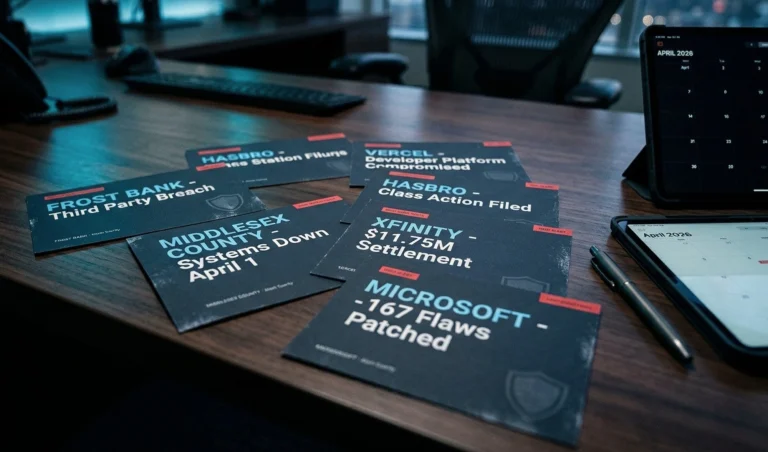
April brought tax season malware, bank data leaking onto dark web forums, a county government knocked offline on April Fools Day (not a joke), and a Patch Tuesday so large it broke its own record. If March felt busy, April did not slow down.
Here is what happened and what it means for your business.
The Breaches
1. Frost Bank and Citizens Financial: Banking Data Leaked via Third Party
Two major U.S. banks, Frost Bank and Citizens Financial Group, were listed on the Everest ransomware gang’s leak site after data from both banks was extracted through a third-party vendor. The stolen data may include Social Security numbers, tax identification numbers, names, financial information, home addresses, income, and account numbers.
Neither bank was hacked directly, but their vendor was, and that was enough.
How it happened: Third-party vendor compromise. This is the supply chain attack pattern that IBM flagged as quadrupling over the past five years. Your security posture is only as strong as the weakest vendor in your network.
2. Middlesex County, NJ: Government Systems Down on April 1st
Middlesex County became a victim of a cyberattack on April 1st, 2026 that impacted its town and public safety systems. The nature and quantity of data compromised are still under investigation.
Public sector continues to be one of ransomware’s favorite targets, and county governments are particularly attractive because they hold sensitive resident data, operate on tight budgets, and often run technology that should have been replaced years ago (but next year’s budget cycle is right around the corner).
How it happened: Under investigation, though the attack pattern mirrors dozens of other local government ransomware incidents this year.
3. Vercel: Developer Platform Breached via Third-Party Tool
Vercel identified a security incident on April 19th involving unauthorized access caused by the compromise of Context.ai, a third-party tool used by Vercel. Hackers claimed to have stolen access keys, source codes, API keys, credentials to internal deployments, and database data.
If your development team uses Vercel, this is worth a conversation with your IT provider about credential rotation and access reviews.
How it happened: Third-party tool compromise. Again. The entry point was not Vercel itself, but a tool it trusted.
4. Hasbro: Data Breach, Class Action Filed
Hasbro fell victim to a data breach after unauthorized access was detected within its network in late March. A class-action lawsuit claims hundreds of employees and customers had their information exposed.
The breach did not stop operations, but the legal fallout is just getting started. This is a reminder that the breach itself is not always the most expensive part.
How it happened: Unauthorized network access (investigation still ongoing).
5. Xfinity: $11.75 Million Settlement, 35 Million Customers Eligible
Over 35 million Xfinity customers affected by the 2023 breach can now claim their share of an $11.75 million settlement by filing a claim before August 14th. If you or your employees are current or former Xfinity customers, that deadline is worth noting.
This one is a few years old but the settlement window is open right now, making it relevant today.
6. Microsoft April Patch Tuesday: 167 Flaws, 2 Actively Exploited Zero-Days
This month’s Patch Tuesday was the largest of 2026. April 2026 Patch Tuesday addressed 167 flaws, including 2 zero-day vulnerabilities being actively exploited in the wild.
If your team has not applied April’s Windows updates, stop reading and go do that. Two of these flaws are being actively used in attacks right now, meaning attackers already know about them and are looking for unpatched systems.
What to do: Confirm with your IT provider that April patches have been deployed across all endpoints, servers, and Microsoft 365 environments.
<h2″>What April Is Telling Us
Three of this month’s biggest incidents share the same root cause: a third party was trusted, that third party was compromised, and the damage cascaded downstream. Frost, Citizens, and Vercel were not hacked directly; their vendors were. Vendor risk management is no longer something only enterprise companies need to think about. Your exposure does not stop at your own front door. Every accountant, logistics provider, software platform, and payment processor you work with is part of your attack surface.
Ask yourself the same three questions we come back to every month:
- Do you know which vendors have access to your systems or data right now?
- Has your team applied April’s patches across all devices?
- Would you know if someone was inside your network today?
If any answer is uncertain, that is where to start.
The businesses that don’t get breached aren’t lucky; they are prepared.
That is exactly what GiaSpace helps Florida businesses do, from locking down vendor access and enforcing MFA to making sure your team is not the last to know when something goes wrong.