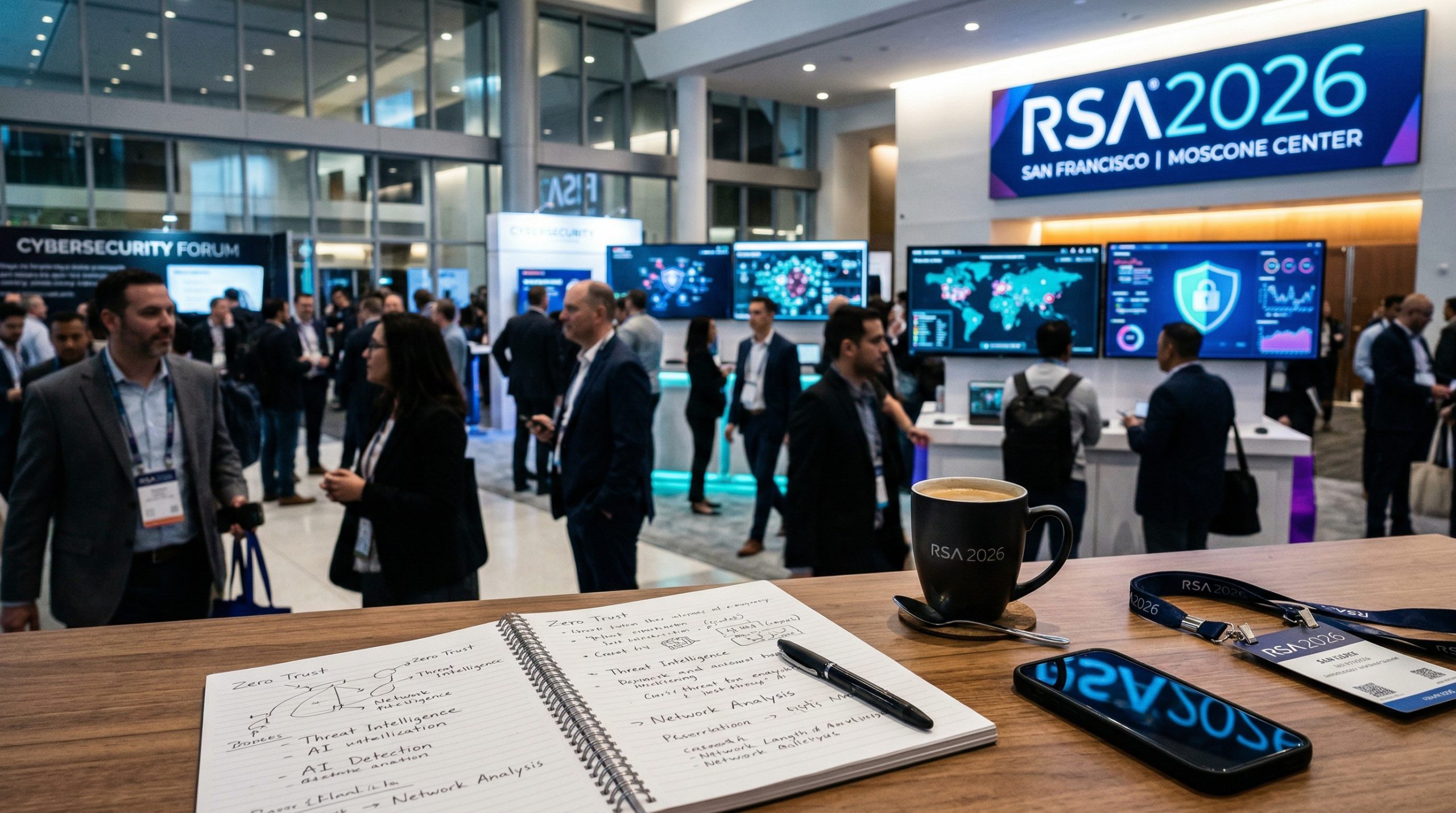
44,000 cybersecurity professionals descended on San Francisco last week for RSA Conference 2026. The theme was community. The actual conversation was AI, AI, and more AI (with a side of passwords being declared officially dead).
If you did not go, here is what you need to know.
The Room Had One Thing on Its Mind
RSA 2026 made one thing clear: the cybersecurity industry has moved past asking “should we use AI?” and is now deep into “how do we secure it before it becomes a liability?”
According to CSO Online, roughly 40% of the entire agenda was AI-weighted. Every panel, every product launch, every hallway conversation came back to the same question: who is actually in control of the AI running inside your business right now?
For most organizations, the honest answer is: nobody.
What Actually Came Out of RSA
1. Agentic AI Is the New Attack Surface
The biggest theme of the conference was agentic AI, which refers to AI that can take independent action without a human approving every step. It is already being deployed inside businesses for security, operations, and automation.
The problem is that most organizations have zero governance around it. Cisco launched a Zero Trust for AI Agents framework specifically to address this, focusing on what AI agents actually do after they gain access, not just whether they are allowed in (which, as it turns out, is the more important question).
What this means for your business: If your team is using AI tools, someone needs to own the question of what those tools can access. Because if you do not know, an attacker will find out for you.
2. Passwords Are Officially Dead
Jim Taylor, president of security at RSA Security, told attendees that traditional passwords have outlived their usefulness. The industry has failed to deliver better alternatives at scale for years, particularly for things like desktop logins that still rely on passwords organizations stopped thinking about a decade ago.
Passwordless authentication, biometrics, and phishing-resistant MFA were all over the show floor. The message was not subtle: if your business is still relying on passwords as the primary line of defense, you are behind.
What this means for your business: Enable MFA everywhere it is not already on, and for higher-risk systems, look at passwordless options. This is not a future consideration anymore.
3. AI vs. AI Is the New Normal
Kevin Mandia from Ballistic Ventures said it plainly at the RSA Annual Executive Dinner: AI agents are already being used in red team exercises and are capable of compressing attack cycles from days to minutes. The new paradigm is AI versus AI, as defenders are racing to automate response at the same speed attackers are automating attacks.
51% of organizations experienced a VPN-related security incident in the past 12 months, according to Zscaler’s report released at the conference, and only 5% trust their VPN to detect AI-enabled threats (which means 95% of organizations are defending against machine-speed attacks with tools that were not built for it).
What this means for your business: Traditional perimeter security is not enough anymore. Detection and response need to be faster than a human can react.
4. Shadow AI Is a Bigger Problem Than Most Businesses Realize
Multiple sessions flagged shadow AI, which refers to AI tools employees are using without IT approval or oversight, as one of the top underestimated risks of 2026. IBM found that shadow AI can add up to $670,000 to a breach price tag when it goes wrong, exposing more data than a controlled deployment ever would.
The parallel to shadow IT a decade ago was made repeatedly, with one key difference: AI tools handle proprietary data, confidential strategy, and client information at a scale that shadow IT never did (your employees sharing the company roadmap with a free AI tool is a very different problem than them using Dropbox without permission).
What this means for your business: Do you know what AI tools your team is using right now? If not, that is the first conversation to have.
5. Identity Is the New Perimeter
The conference reinforced what the biggest breaches of 2026 have already shown: attackers are not hacking in, they are logging in. Identity, not the network edge, is now where most attacks begin and end.
Accenture and Anthropic jointly launched Cyber.AI, a security operations platform built around Claude as its central reasoning engine, specifically designed to manage identity threats at machine speed. The fact that a Big Four firm and an AI lab teamed up to ship a security product tells you everything about where the industry is headed.
What this means for your business: If a single set of admin credentials can take down your entire environment (for example: Stryker Hack), your identity controls need attention before anything else.
The Takeaway
RSA 2026 was not a conference about future threats. It was a conference about threats that are already here and defenses that are not keeping pace.
The businesses that walked away with something actionable were not the ones who tried to absorb every session. They were the ones who asked one honest question: do we actually know what is running inside our environment right now?
If the answer is uncertain, that is where to start.
The businesses that don’t get breached aren’t lucky; they are prepared. Closing that gap does not take a team of CISOs. It takes the right partner and a clear starting point.
→ Schedule Your Free Security Assessment with Rob
→ Learn More About Our AI and Automation Services
Published: Apr 6, 2026
Need IT Support for Your Florida Business?
GiaSpace provides proactive managed IT services, cybersecurity, and local tech support across Florida — with teams in Gainesville, Fort Lauderdale, Jacksonville, and Ocala.
Managed IT Services FloridaCybersecurity Services FLGainesville IT ServicesFort Lauderdale IT Services